An SEO audit with 200 issues is not a plan
Published on Sep 10, 2026
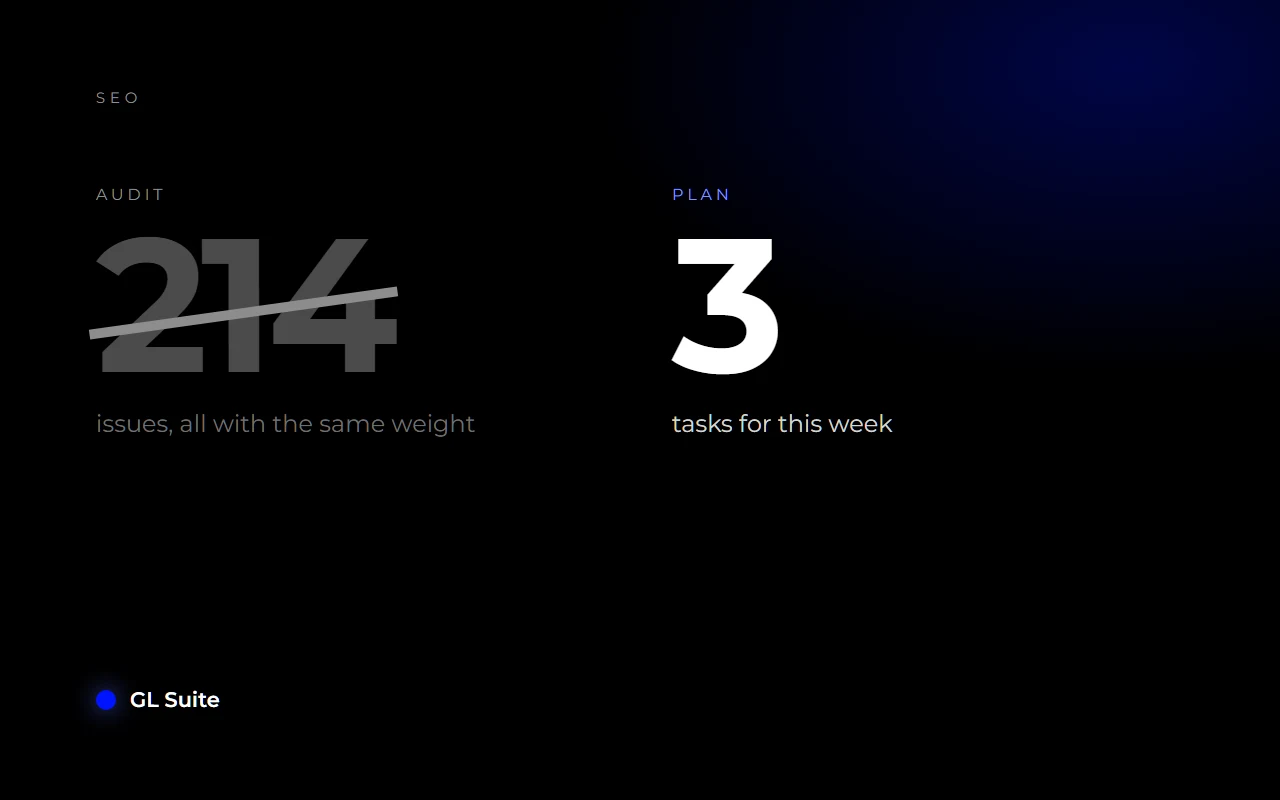
You know the scene. Someone runs an audit on the site, the tool returns 214 issues, the number goes on a meeting slide and everyone agrees the team needs to "work on SEO". Three months later, the same audit returns 209.
It isn't a lack of will. A list of 200 items with no order isn't a decision. It's a pile.
Every issue shows up with the same weight
Audit tools are good at detecting and bad at ranking. A key page blocked by noindex and a decorative image without alt text land in the report as two identical lines, sometimes in the same color.
Anyone who doesn't live and breathe SEO reads them as equivalent and starts with whatever is easiest to fix. That makes sense when you're looking at a list. It makes no sense for traffic.
An order that works for most sites
There's no universal rule, but this sequence covers a lot of cases.
1. Whatever stops Google from seeing the page. noindex where it shouldn't be, robots.txt blocking an entire section, a canonical pointing to another URL, an important page returning an error. If the search engine can't index it, nothing else on the list matters for that page.
2. Whatever is almost working. Pages that already show up in search, but far from the top. Improving what already gets impressions usually pays off faster than trying to rank a page from scratch.
3. Whatever you fix once and applies to many pages. A badly built title in the product template shows up as 400 issues in the audit, but it's a single fix. Separate template problems from page problems.
4. Everything else. Meta description length, alt text on decorative images, headings out of order. Worth fixing, just later.
The Monday test
Take your latest audit and try to answer one question: what does the team fix this week? If the answer is "we'll start with the report", the audit hasn't become a plan yet.
A good audit fits into three or four tasks for the next few days, each with a reason for being there. That's what led us to build SEOme: the triage we used to do by hand for every client, now delivered as a list of what to fix first.